
Expose Risks BeforePolicies Enter Production
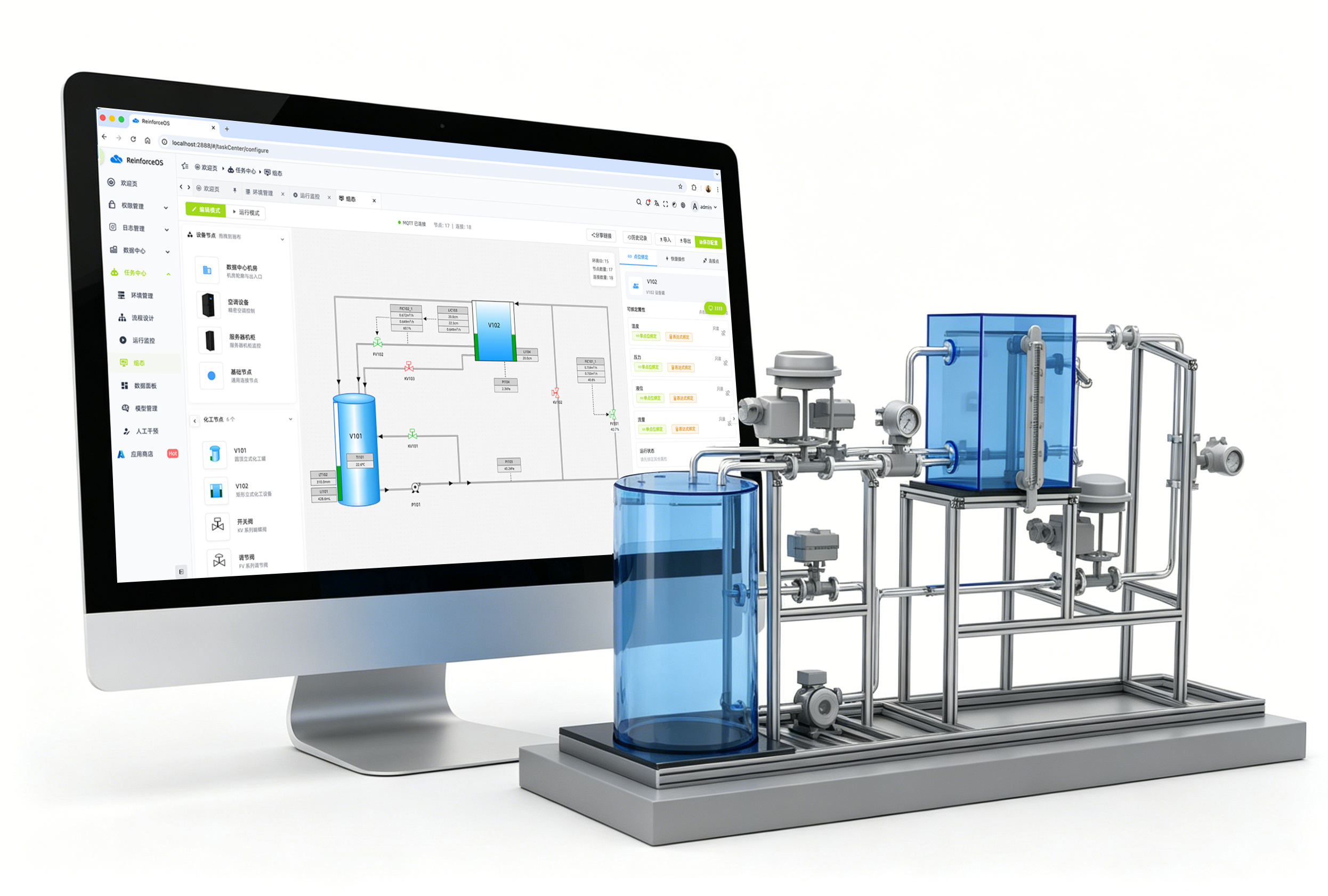
ReinforceLab is built around real control units used in industrial settings, constructing physical apparatus to replicate core control challenges in complex production environments — providing a low-cost testbed for control strategies and ensuring optimization methods undergo rigorous stability validation and quantitative evaluation before entering production.
Why ReinforceLab
Why ReinforceLab
Not a simple data simulation — but a systematic establishment of validation gates, evidence, and decision criteria required before policy go-live.
Standardize the Pre-deployment Process
No longer relying on verbal experience or scattered scripts — forming a standardized process of data ingestion, replay, testing, and evaluation.
Validation Results Are Quantifiable
Output comparison results around energy consumption, yield, purity, stability, and boundary triggers — not just subjective judgments.
Minimal Production Interference
Through shadow mode and parallel validation, new policies "prove themselves" in real data streams before being allowed to take over.
Expose Risks Early
Boundary violations, anomalous condition behavior, and version differences are explicitly identified before go-live — reducing production trial-and-error costs.
Core Modules
Core Validation Modules
Offline Replay Validation
Reproduce policy behavior across different operating conditions using historical data — comparing baseline and optimized policy returns using a consistent yardstick.
Shadow Mode Online Parallel
Without interfering with field production, the new policy runs in parallel with the current control logic — comparing outputs and observing risks.
Multi-dimensional Quantitative Evaluation
Not just a single metric — simultaneously evaluating return, stability, boundary trigger frequency, operational smoothness, and anomaly behavior.
Safety Boundary & Version Validation
Policies must pass boundary rules, anomalous condition responses, and version comparison checks before entering production — providing a clear go-live threshold.
Workflow & Evidence
Standardized Validation Process
Formalize the required steps every policy must go through before production — giving go-live decisions a traceable evidence chain.
Typical Validation Path
Data Ingestion & Baseline Definition
Ingest historical data and real-time conditions — define the manual policy, existing control logic, or reference version.
Offline Replay & Boundary Check
Validate policy behavior on historical data across normal and boundary conditions, checking constraint compliance.
Shadow Mode Parallel Validation
Run the new policy in parallel on the real data stream, comparing output differences with the existing policy.
Quantified Report & Go-live Recommendation
Aggregate returns, risks, anomalies, and recommended actions — forming the evidence basis for the go-live decision.
Validation Inputs
Evaluation Outputs
Decision Materials
Reports & Decision Support
Turn Validation Results into Go-live Decision Evidence
Distill results, risks, and recommendations into communicable decision materials.
Decision Layer
Not "done when testing is done"— risks, returns, and thresholds spelled out clearly
Validation outputs cover more than performance improvement — also boundary triggers, anomalous condition behavior, manual policy comparison, and version differences, enabling joint decisions by process, control, and management teams.
Go-live Gate
Explicitly configurable
Result Comparison
New vs. old — same yardstick
Risk Exposure
Identified before go-live
Report Archive
Full-process traceable
Multi-version Comparison
Support side-by-side comparison of manual baseline, old version, and new version policies — eliminating debates about whether things actually improved.
Boundary & Rule Validation
Safety boundaries, operational limits, and anomaly responses built into the validation workflow — go-live is not a gut-call decision.
Structured Result Archiving
Effect charts, evaluation metrics, risk descriptions, and go-live recommendations distilled into structured outputs for team review.
Continuous Iterative Optimization
Every new trained version enters the same validation workflow — forming a stable policy iteration and acceptance mechanism.
Use Cases
Use Cases
Pre-deployment Acceptance for New Policies
For any control policy project that needs to prove returns and safety before entering the production environment.
APC / MPC Replacement & Upgrade
Before switching between old and new control logic, validate returns, stability, and boundary differences using a consistent yardstick.
Pre-change Assessment for High-risk Conditions
Suitable for pre-deployment validation of load switching, feedstock variation, equipment aging, and other high-risk scenarios.
Projects Requiring Quantified Delivery Reports
When project acceptance requires quantifiable evidence and report materials, the validation platform provides direct structured support.
Get Started
Validate First, Then Go Live
If you want to clearly articulate policy returns, boundary behavior, and risks before entering production, we can build the validation process, acceptance criteria, and report outputs together.